





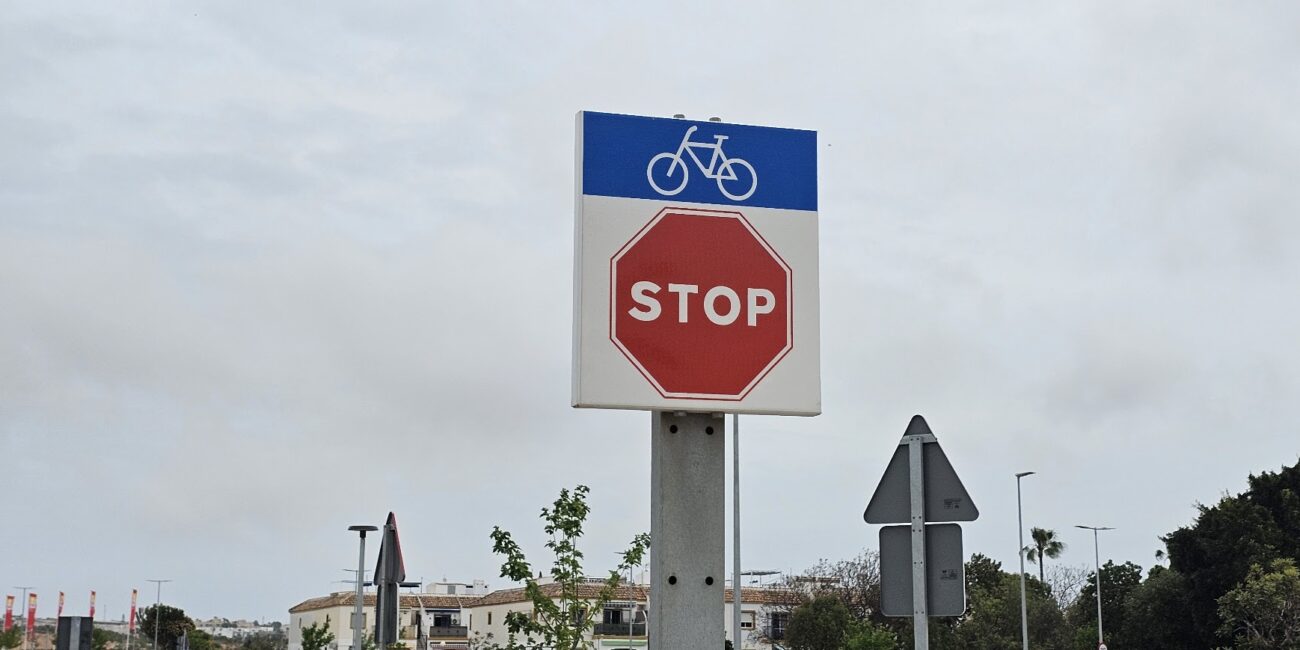
Have you ever noticed those miniature STOP signs and pint-sized white lines painted across cycle paths and cycle lanes? It can be tempting to treat them as gentle advisories, but Spanish traffic law is unequivocally clear: size really does not matter.
A reduced-scale STOP sign on a cycle path carries the exact same legal obligations as any full-sized road sign. It demands an absolute, complete halt. Furthermore, on a two-wheeled vehicle like a bicycle, that requirement is strictly defined: you must place at least one foot firmly on the ground to ensure complete balance and stability before proceeding. Merely slowing down, rolling across the line, or balancing on the pedals does not fulfil your legal duty, leaving you liable to a penalty in euro.
Yet, this rule is not merely about avoiding fines or keeping on the right side of traffic law. As we have discussed in our previous road safety features, bringing your vehicle to an actual standstill gives the brain the necessary seconds to properly register your surroundings. A rolling stop frequently triggers inattentional blindness, where a road user looks directly in the direction of oncoming traffic but fails to mentally process an approaching hazard.
When transitioning from a minor cycle lane onto a major road, vulnerability is already high. For a cyclist, lacking the physical cabin and structural protection of a motor vehicle, a side-on collision from an unnoticed car or lorry can be devastating and easily fatal.
Never assume a smaller sign means lesser importance. Give yourself the time to see and be seen: stop completely, place your foot down, verify that the carriageway is clear, and keep yourself safe on the road.
Other Articles




No Comment! Be the first one.